Tag: Community

Guy Wires Play a Critical Role in Community Safety

While they may not look dangerous, guy wires play an important role in maintaining the safety and reliability of the electric system. Indiana’s electric cooperatives reminds consumers to be aware of these important support structures and follow a few simple precautions to help prevent accidents.

Guy wires can be found throughout the community. They are tensioned cables attached to utility poles, radio towers, tents, and other tall structures to help keep them stable. They are typically anchored in the ground and attached to utility poles to help support the structure against the constant pull of power lines. They are under high tension, so they shouldn’t be tampered with.

If a guy wire is loose, bent, or cut, it can compromise the stability of the entire pole. In some cases, that could lead to leaning poles, sagging lines, power outages, or injuries.

Yellow or plastic covers are often found near the bottom of some guy wires. These are called guy guards and help make the wires easier to see so people don’t accidentally walk or drive into them.

Indiana’s electric cooperatives encourage consumers to follow these safety tips around guy wires:

  • Don’t attach anything to a guy wire: Signs, decorations, pet leashes, and sports equipment can strain the wire or the anchor over time.
  • Be careful when mowing, trimming, or digging nearby: Hitting a guy wire with lawn equipment can damage it and create a safety hazard. If you are planning a project such as planting a tree or installing a fence, give the guy wires plenty of space. Call 811 if you plan on digging on your property.
  • Remind children not to play on or around guy wires: They may look like fun to climb, but they aren’t designed for play.
  • Speak up if something looks wrong: If you notice a guy wire that’s loose, damaged, or disconnected from the ground, contact your local electric cooperative to have it checked by a professional.

While they may not look dangerous, guy wires play an important role in supporting infrastructure that powers homes, businesses, and communities. Staying aware of a few basics can help prevent accidents.

Students Invited to Experience Indiana Government During Page Day

This winter, high school students from across Indiana will have the opportunity to experience state government firsthand during Page Day, hosted by Indiana Electric Cooperatives on Tuesday, Jan. 26.

The event will allow students to engage with government leaders, connect with peers, and explore the legislative process through hands-on activities at the Indiana Statehouse, including a tour, mock bill activity, and educational sessions.

“Advocacy is an important part of strengthening our communities, and Page Day helps students understand how they can contribute,” said Ryan Dant, CEO of Daviess-Martin County REMC. “The experience introduces young people to the legislative process and empowers them to engage in issues that matter to their future.”

High school students, including those who are homeschooled, are eligible to apply. There is no cost to attend Page Day. Students are responsible only for arranging transportation to and from the Indiana Statehouse.

To apply, visit IECPageDay.org. Applications open on Nov. 2, and the application deadline is Jan. 8.

For more information about the 2027 Indiana Electric Cooperative Page Day, contact Karlee Gable, 317.487.2235 or kgable@indianaec.org.

Student Art Contest Opens to Indiana K-12 Students

It’s time to let your creativity shine as Indiana’s electric cooperatives invite all Indiana K-12 students to enter the Wired to Create Student Art Contest.

Hoosier students will be tasked with creating artwork that shows the people, places or activities that help power our state and keep Indiana moving forward. This could include people, nature, agriculture, landscapes, businesses or moments from everyday life in your community.

Students will be judged in four grade divisions: K-2, 3-5, 6-8 and 9-12. First-, second- and third-place winners will be selected from each grade division. Each first-place artist will receive $200, second-place artists in each grade will receive $100, and third-place artists will receive $50. One “Best of Show” winner will also earn an additional $100. That’s up to $300 in prizes!

The artwork will be judged on artistic merit, originality and creativity. Indiana public, private or homeschooled students in kindergarten through 12th grade during the 2026-27 school year are eligible. Students do not need to be consumers of a rural electric cooperative (REMC/REC) to enter.

“We are proud to be a part of recognizing and showcasing the artistic talents of our youth. We are excited to see what artwork will be submitted and think this is a great way to highlight our communities,” said Ryan Dant, CEO of Daviess-Martin County REMC.

A complete set of rules, instructions, required entry forms and additional contest information is available at goiec.org/artcontest.

All entries must be submitted online or postmarked by March 5, 2027.

Why Every Outdoor Project Should Begin with Safety

Outdoor projects such as landscaping, fence installation, tree planting, and mailbox replacement can improve your property. They can also create serious safety risks if utility lines are not properly identified first. Before starting any project that involves digging, homeowners should think about utility safety both below and above ground.

Before starting any digging project, homeowners should contact Indiana 811 online or by dialing 811 to have public underground utility lines marked. Underground utility lines may be closer to the surface than expected, making it important to locate them before digging begins.

Striking an underground utility line can cause injuries, outages, expensive repairs, or service disruptions for your neighborhood.

Indiana law requires contacting Indiana 811 at least two full working days before excavation begins, excluding weekends and holidays. After a request is submitted, utility operators will mark the approximate location of underground lines using paint or flags.

Indiana 811 marks public utility lines leading to the utility meter. Private utility lines, such as those connected to outdoor lighting, irrigation systems, detached garages, or fire pits, may not be marked and could require a private locator.

Homeowners should also look above ground before beginning outdoor projects. Ladders, long-handled tools, tree limbs, and other materials can come dangerously close to overhead power lines.

Trees and landscaping should never be planted too close to overhead power lines or utility poles. Trees growing into power lines are one of the leading causes of outages during storms and high winds. Branches contacting power lines can interrupt electric service and create dangerous conditions.

When planning landscaping projects, homeowners should also keep pad-mounted transformers and other utility equipment clear and accessible for utility crews. Shrubs, fencing, mulch, and decorative landscaping should not block access to electrical equipment.

Taking a few extra steps before starting a project can help protect your family, property, and electric service.

Source: Indiana 811

Remembering Larry Brochin: A Legacy of Service to REMC and Beyond

Daviess-Martin County REMC has proudly served our members for nearly a century, and during that time, many dedicated employees have devoted their careers to keeping the lights on in our communities. Among the many dedicated employees who have served our cooperative, one name continues to stand out: Robert Lawrence Brochin, better known to most as Larry.

Larry was a proud patriot who honorably served his country in the U.S. Marine Corps. After returning to civilian life, he began what would become a long and distinguished career with Daviess-Martin County REMC. He started as a lineman in 1966 and worked his way into management before retiring in 2002 after 36 years of dedicated service.

Larry’s commitment to serving others extended well beyond his career at the cooperative. He had a passion for mentoring young people and spent many years coaching cross-country at Washington Catholic High School, as well as girls’ middle school basketball. Those who knew him best described him as someone who was always willing to lend a helping hand and volunteer whenever needed.

On June 14, 2026, Larry passed away at the age of 86 in Washington, Indiana. He was a longtime member of St. Mary’s Catholic Church, a Fourth Degree Knight of Columbus, and a member of the IBEW. Throughout his life, he exemplified dedication, service, and integrity.

His contributions, strong work ethic, and unwavering commitment to our members helped shape Daviess-Martin County REMC into the cooperative it is today. His legacy will live on through the countless lives he touched, and his service to our country, cooperative, and community will not be forgotten.

Summer Starts With Safety: Daviess-Martin County REMC Delivers Hands-On Power Line Safety Demos

Summer is in full swing, and students from area schools are enjoying their time away from classes. Whether biking or fishing at West Boggs Park or spending time at the municipal pools in Loogootee and Washington, they are likely to encounter electrical infrastructure, which makes it important that they understand the real dangers associated with electricity.

That’s why, before classes ended for the 2025–2026 school year, Daviess-Martin County REMC (DMREMC) was invited to share power line safety information with students at a local elementary school and at an educational camp.

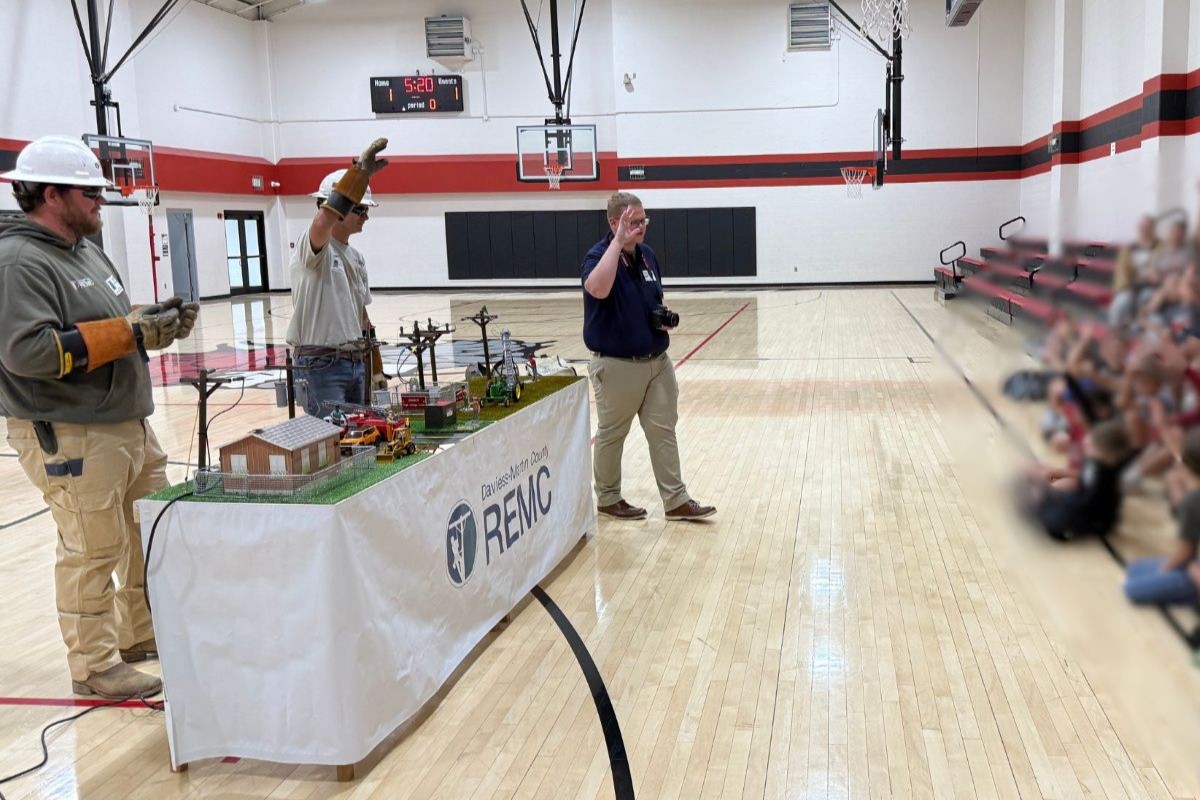
The first stop was Barr-Reeve Community Schools, where journeyman linemen Jarrett Arvin and apprentice lineman Jeremy Maddox spoke with a group of second-grade students about basic power line safety. Both emphasized the importance of staying aware of their surroundings, including what is above and below them while playing outside.

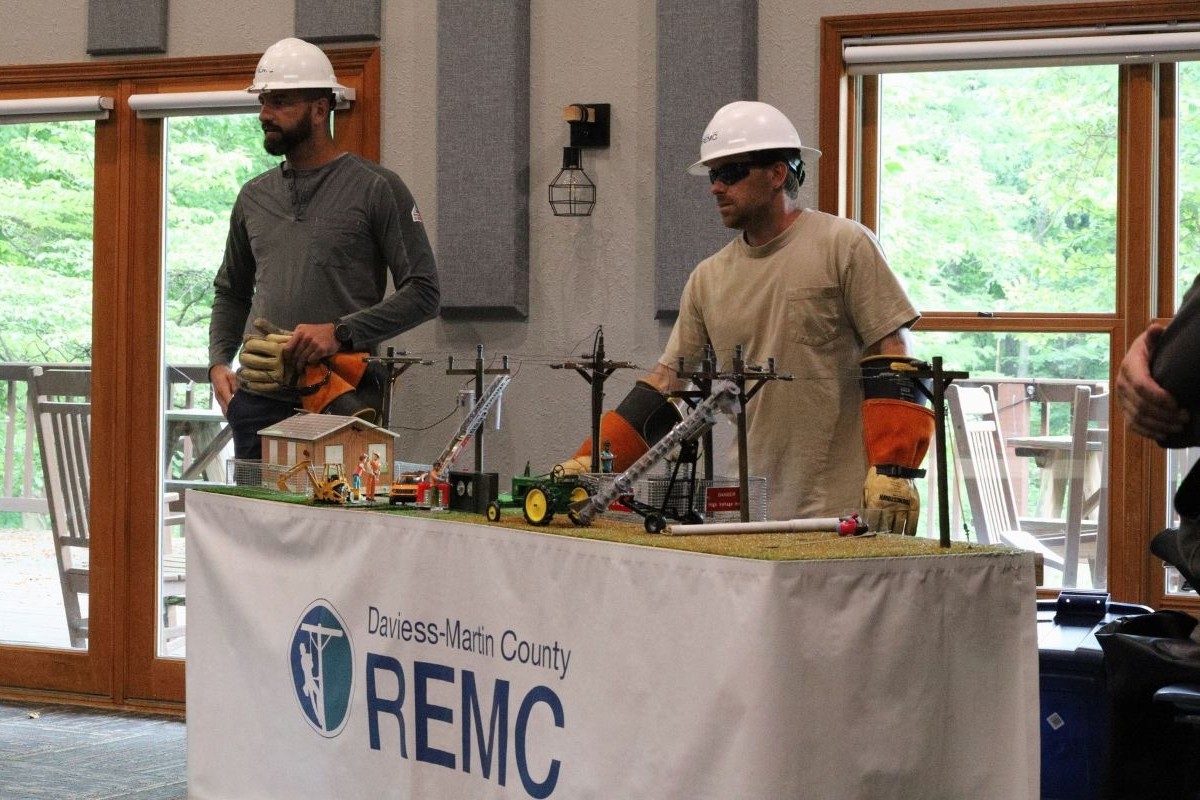
The tabletop demonstration featured a series of real-world scenarios illustrating what can happen when someone encounters a live power line. Examples included downed poles caused by fallen trees, kites becoming entangled in power lines, and the dangers of digging near underground utilities.

Students remained highly engaged throughout the presentation, especially when viewing live electrical arcing safely performed by DMREMC-trained professionals.

The following week, journeyman linemen Dwain Jolliff and Tyler Bostock visited a group of young men during the Ebenezer Boys Camp at Camp Illiana. These students had spent part of their time at camp learning basic electrical concepts, which were reinforced through the safety demonstration.

The campers asked many thoughtful questions, creating a highly engaging learning environment for everyone involved. Questions ranged from utility location procedures to what it takes to pursue a career as a lineman.

By connecting real-world demonstrations with hands-on learning, DMREMC continues to reinforce the importance of electrical safety and help students build awareness that can last well beyond the summer months.